Beyond CAR T Cells: How Bispecific Engagers, NK Cells, iNKTs and Ultrasound-Gated Gene Circuits Are Reshaping Solid Tumor and Autoimmune Therapy
A tour of next-generation immunotherapies — BiTE engagers, high-dose NK and iNKT cell products, and ultrasound-triggered gene circuits — and why each is aimed at gaps CAR T cells leave open.
The gap CAR T cells still can't fill
CAR T cell therapy is the closest thing immunology has had to a genuine breakthrough: seven approved products for blood cancers, including Kymriah and Yescarta, as the Alliance for Cancer Gene Therapy tracks. But two hard limits show up almost every time the field pushes beyond hematologic malignancies. First, solid tumors are hard to hit. Most solid tumor antigens aren't tumor-specific, and the ones that are tend to be patchy and can disappear over time as the tumor evolves, which is why CAR T cells stall outside of leukemia and lymphoma. Second, the in vivo expansion that makes CAR T cells so potent is also what causes the two worst side effects in the box: cytokine release syndrome and immune effector cell-associated neurotoxicity syndrome. Add to that a manufacturing step that's bespoke and expensive per patient, and you get a therapy that's spectacular where it works and structurally difficult where it doesn't.
That's exactly why a wave of alternative and complementary approaches is moving through the pipeline. The through-line is simple: keep the immune-redirecting logic, drop the dependence on mass in vivo T cell expansion, and find a way to make the therapy off-the-shelf, cheaper, and usable in settings that aren't a large academic cancer center.
Bispecific T cell engagers: off-the-shelf redirection
Amgen's BiTE platform is the most clinically mature of these alternatives, and it's been around for decades. The mechanism is straightforward. A BiTE molecule binds CD3 on a patient's own T cells on one end and a chosen tumor antigen on the other, physically dragging T cells into killing range of the tumor cell and activating T cell mediated killing without needing to engineer the T cells first. Jean-Charles Soria, Amgen's senior vice president for global oncology development, frames it as filling a gap that has been real since the platform was built: "For 30 years, we have built on this science, first in blood cancers and more recently in solid tumors."
The key design choice is target selection. Because BiTEs rely on T cells that the patient already has, they work best when the target antigen is expressed consistently on the tumor and minimally on healthy tissue. That's why Amgen has been focused on solid tumors like small cell lung cancer, where immunotherapy has historically struggled. A specific asset they've highlighted is xaluritamig, an investigational STEAP1-targeted BiTE in advanced development for prostate cancer. The company says it's also exploring whether BiTEs can be combined with other novel mechanisms of action, which is a sign that the field is moving from "which single modality wins" to "what does this platform do in combination."

NK cells: potency without the expansion problem
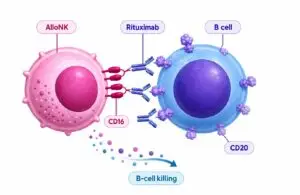
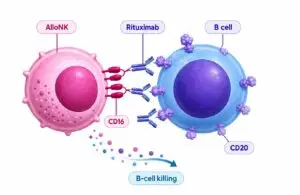
The second big shift is toward natural killer cells. Artiva Biotherapeutics, a spin-off of Korea's GC Cell, built its whole strategy around one fact: NK cells don't expand in vivo the way T cells do. That single difference removes the two most feared side effects of CAR T therapy, CRS and ICANS, and it also means the therapy can be delivered outside a large hospital. The company's lead asset, AlloNK, pairs high-affinity CD16 NK cells with a monoclonal antibody like Rituxan. The antibody does two jobs. Its Fab region binds the antigen on the B cell, and its Fc portion binds CD16 on the NK cell, creating a three-way complex that triggers killing. Fred Aslan, Artiva's CEO, describes the goal bluntly: "The role of any cell therapy is to very potently kill the pathogenic B cells."
The economics matter here. Artiva manufactures its NK cells from umbilical cord units that carry the high-affinity CD16 variant. One unit yields about 50 intermediates, each producing roughly 80 billion cells, which at a dose of eight billion cells per patient is enough for about 500 patients from a single cord. Aslan says the cost of goods is a full order of magnitude below autologous CAR T. Early comparative data the company has generated so far covers roughly 150 patients across two oncology and five autoimmune indications. In rituximab-alone arms, an average patient still had a measurable B cell residual of one cell per milliliter of blood; in the combination arm, B cells were not detectable across the indications. In aggressive non-Hodgkin lymphoma and Hodgkin lymphoma, response rates and durability matched autologous CAR T. The company's lead indication is refractory rheumatoid arthritis, with a Phase III readout expected in 2028.
TriNKETs and the CCR6 strategy
Dragonfly Therapeutics is pushing the NK angle further with a different design. Its platform spans six targets, CCR6, CD19, BAFFR, FAP, CD52 and BCMA, each aimed at a different pathogenic cell population and a different disease, from lupus nephritis to fibrosis to amyloidosis. The novel molecules include both first-in-class monoclonal antibodies and trispecific immune cell engagers, or TriNKETs. A TriNKET has three binding arms: one for an antigen, one for NKG2D, and one for CD16, both of which are activating receptors on NK cells.
The argument for using NK-based engagers in autoimmune disease is that they deliver the same goal as CAR T, deep depletion of pathogenic B cells and a kind of immune reset, but without the clonal expansion phase, the lymphodepletion step, or the gene modification that creates a small secondary malignancy risk. Because NKG2D activation is already tuned by the body to respond to stressed cells, the dose window between "effective" and "harmful" is wider. The half-life is measured in days, so the effect is dose-controllable and reversible.
The company's most clinically advanced autoimmune asset is DF5112, a CCR6-targeting monoclonal antibody. It's designed to deplete the specific cells that drive tissue inflammation in psoriatic arthritis, rheumatoid arthritis, lupus, and hidradenitis suppurativa, namely Th17 cells and a subset of memory B cells, while sparing most of the rest of the immune system. DF5112 is described as the first molecule to deplete both of those populations at once, and it's near the end of Phase I with early data expected in late 2026.
iNKT cells: a different kind of T cell
There's a less-discussed population sitting between innate and adaptive immunity: invariant natural killer T cells, or iNKTs. These cells carry an internal targeting and homing device, the iTCR, and they naturally home to tissues, promote tumor killing and viral clearance, and suppress inflammatory cytokines and graft-versus-host disease. MiNK Therapeutics is betting that this biology makes iNKT cells a foundational tool for immune restoration across a broad range of conditions. In native form, iNKTs have shown benefit in solid tumors; the company has also shown that the cells can be engineered or edited for "super-targeting."
The lead program, agenT-797, is an allogeneic, off-the-shelf iNKT cell therapy being evaluated in virus-induced acute respiratory distress syndrome, where a favorable safety profile, improved survival, and lower secondary infection rates have been observed. Notably, clinical data so far show no neurotoxicity or CRS at a dose of one billion cells, which is a meaningful safety margin for a therapy that's designed to be given broadly rather than in a heavily monitored setting.
Ultrasound-gated gene circuits for solid tumors
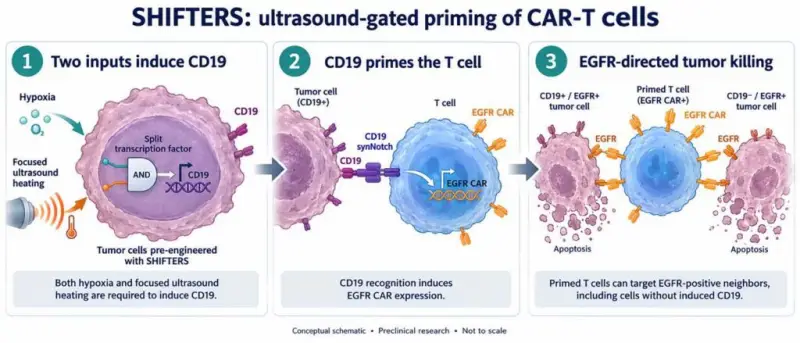
The most experimental entry on this list is a USC team's approach to the core solid tumor problem, which is that almost no antigen is found exclusively on tumor cells. Their answer is to install one, but only inside the tumor, using a two-key genetic circuit called SHIFTERS. The design pairs two inputs. Tumor hypoxia turns on one half of a split Gal4-VP64 transcription factor, and focused ultrasound heating turns on the other. Only when both halves are present does the circuit assemble and switch on expression of CD19, an antigen that's already clinically validated as a CAR T target.
The trick is the selectivity. Hypoxia alone is a reasonable "tumor address" but a dangerous one, because the brain, liver, bone marrow, and gut are all physiologically low in oxygen. Focused ultrasound gives a precise physical address but heat-shock-driven expression is a brief spike that fades before T cells get to work. Gating the two together means the circuit only fires at tumor-like oxygen levels, around one percent, and ignores normal low-oxygen tissue. In their tests, the circuit holds CD19 expression at 60 to 80 percent through 72 hours, then returns to baseline by about day six, long enough for the therapy to work and short enough to stay safe. Inducing CD19 in just 25 percent of tumor cells was enough to kill more than half the population once primed T cells arrived.
The circuit is modular. Swapping the hypoxia input for a liver-cancer-specific promoter reproduced the process in liver cancer cells only, with near-zero activity elsewhere. The team's next steps are to add ultrasound-gated cytokines like IL-2, IL-18, and interferon gamma to counter the tumor's immunosuppressive microenvironment without systemic toxicity, build a library of other tumor-hallmark promoters, and work out the right ultrasound dosing schedule in immunocompetent models.
What's still open
None of these platforms is a settled answer yet. BiTEs have been in play for decades and are now reaching into solid tumors, which is real progress but a long road from discovery to approval. The NK-based strategies are early; Artiva's Phase III readout isn't until 2028, and Dragonfly's DF5112 data are still to come. iNKT therapy is being explored in respiratory disease rather than the solid tumors it originally showed benefit in. SHIFTERS is a preclinical, AI-schematic, two-input genetic circuit that still needs the ultrasound dosing and immunocompetent-mouse work done. What they share is a coherent logic: if the bottleneck in the next generation of immunotherapy is the combination of T cell expansion, off-the-shelf manufacturing, and solid tumor antigen selection, then the most interesting work is the work that attacks all three at once, and each of these programs is taking a different cut at it.