AI Protein Design Moves Closer to Real Drug Candidates
Companies are testing AI-designed antibodies and minibinders in labs and early trials, but the data so far is promising rather than proven. Here's what's new.
Most drug programs don't fail because the idea was bad. They fail late, after months of work and millions spent, when a promising molecule turns out to be unstable, hard to make, or simply doesn't behave in a patient. That's the expensive problem AI protein design is now trying to shrink. The question isn't whether models can generate proteins on a screen. It's whether they can produce molecules that survive the lab, the clinic, and a manufacturing line. Several groups are starting to show data that bears on that, and the picture is more interesting than the hype suggests.
Sanofi is splitting the problem into three jobs
Sanofi's biologics AI team organizes its work into three linked efforts. Norbert Furtmann, PhD, head of biologics AI and design, describes foundational models that learn from sequence and structure, a property-prediction and virtual-screening group, and a de novo design team. The foundational models are trained to "speak the language of proteins," as Furtmann puts it, using a mix of public and in-house data.
The screening group is where the economics come in. It builds models that predict properties needed for function and developability, including stability, solubility, and affinity. Those models run large in silico screens across hundreds of thousands of sequences and decide which designs earn a spot on the bench. That's a filter, not a guarantee, but it means the lab sees fewer candidates that were never going to work.
Furtmann says the de novo team's early proof-of-concept work on therapeutically relevant targets has been strong enough that the company is now looking to scale it. Starting from a target antigen structure, the team uses the model to propose antibodies or nanobodies against it, and the scientists reported creating functional binders that are now moving into multispecific formats.
Multispecifics are where the search space explodes
Multispecifics are the reason this matters so much to Sanofi. Imagine you've optimized antibody or nanobody building blocks against targets A, B, and C, and now you want to join them. The number of possible combinations is enormous. "That could easily go into the hundreds of thousands of molecules, and you could not test all of them in a lab," Furtmann says.
Here's the thing that's easy to miss: a good monospecific binder doesn't guarantee a good multispecific. Furtmann's point is that you have to design the building blocks with the final format in mind. "If you have a monospecific molecule, and then you plug five of them together for a multispecific, and they don't behave well anymore, you need to start optimization again," he says. That kind of rework is exactly what drives timelines out.
To close the loop, Sanofi runs what it calls a "lab-in-the-loop" workflow. AI-generated designs get synthesized, measured, and the results go back into the model to refine the next round. The company has invested heavily in automation to get fast, reproducible measurements, because a feedback loop is only as good as its data. Furtmann says the goal is that integration applies to monospecific optimization and, especially, to the harder multispecific molecules.
Biolojic is betting on antibodies that bind more than one target
Biolojic Design, with sites in Ness Ziona, Israel and Washington, DC, takes a different route. It uses AI to build what it calls "multibodies": standard human antibodies engineered to bind two or more targets. The key difference from bispecific antibodies is structural. Bispecifics are assembled from fragments of two different antibodies. Multibodies keep the conventional human IgG architecture, which means they can lean on the manufacturing, pharmacokinetic, and safety experience that comes with ordinary antibodies.
The idea rests on an observation about how antibodies are built. Antibodies recognize targets through six complementarity-determining regions, or CDRs, yet only a small fraction of that surface usually contacts the antigen. Yanay Ofran, PhD, founder and CEO of Biolojic, calls this "free real estate." "If you look at known antibody-antigen pairs, most of the CDRs are not involved in binding," he says. "Our models allow us to precisely identify the free real estate and 'develop' it to accommodate additional binding."
Each arm of a multibody binds one target at a time, but the drug's behavior depends on context. The company argues that this conditional binding could help with tumor heterogeneity, since the same molecule may engage differently depending on the tumor, tissue, or patient, while limiting off-target interactions. That's a design hypothesis, and it needs clinical confirmation before anyone should read much into it.
Biolojic's workflow is unusually specific. Rather than building one general-purpose model, the team fine-tunes temporary, specialized models for each project. Ofran describes it as "a concentrated effort of a couple of months to build a dedicated model that will make one drug that no other technology can make and then will be retired." Existing models first propose roughly a billion antibodies, each predicted to have a desired property. The team synthesizes variants, measures binding affinity, expression, specificity, and stability, and feeds those results back to refine the model. The final model proposes candidates that combine all the required traits, and those go to the lab.
The clinical marker here is a conditional agonist/antagonist that binds the cytokine IL-2 in a context-dependent way. In principle, it stimulates T cells that attack a tumor while blocking T cells that protect it. That asset, now in Phase II trials, is being developed by Biolojic's spinout, Aulos Bioscience. Ofran says safety and efficacy data have been encouraging so far. Phase II is a meaningful step, but it's still an early read on whether the concept holds in patients.
Ofran is also clear about the ambition. Speed and cost matter, he says, but the bigger aim is molecules that traditional discovery is unlikely to produce at all. "Not to accelerate the time for getting the same type of molecules that you will get otherwise, but to get molecules that do things that traditionally discovered molecules cannot do."
Better benchmarks are the missing piece
Comparing AI design methods is harder than it looks. When each group reports results on different targets, with different assays and different metrics, it's almost impossible to know which model is actually better. That's the gap A-Alpha Bio, based in Seattle, is trying to fill. Natasha Murakowska, PhD, director of applied machine learning at A-Alpha, frames the core questions plainly: "What is the kind of data that helps build better models? What will it require to do this sort of de novo design perfectly every time?"
A-Alpha is running a large VHH de novo design benchmark. About a dozen groups have been invited to each submit 10,000 designed antibody sequences. A-Alpha will synthesize and test them against a panel of 10 targets, producing roughly 110,000 VHHs. The goal is an apples-to-apples comparison that measures not just whether antibodies bind, but how strongly, how specifically, and which sequence or structural features separate the winners from the rest.
The measurement engine is AlphaSeq, a library-on-library yeast display assay. One library encodes the antibodies and the other encodes the targets, so the experiment effectively measures all pairwise interactions. Murakowska says a single experiment generates on the order of one million quantitative protein-protein interaction data points. That's the kind of dataset that can reveal off-target effects alongside affinity, which is exactly what a fair benchmark needs.
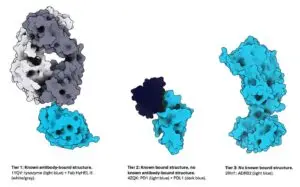
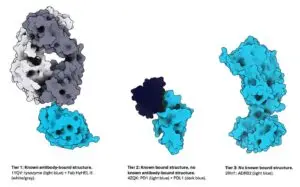
The benchmark is stratified into three difficulty tiers. In Tier 1, a known antibody-antigen crystal structure is provided, and models must design variants that improve binding. Tier 2 gives only the antigen's structure, so the model has to pick a bindable epitope and design a complementary interface. Tier 3 is what Murakowska calls the "holy grail": no structural information at all. The model must infer the antigen's structure, identify a druggable region, and design an antibody for it. "It stacks complexity, and it tasks model makers in multiple ways," she says. Solving it means representing the right protein, the right epitope, and then designing for that surface.
Data is the bottleneck behind all of this. A-Alpha recently launched the Atlas Consortium, a collaborative effort in which companies of very different sizes jointly generate shared AlphaSeq datasets under a common experimental framework. A-Alpha produces new datasets each quarter, pools them, and shares them with members. The selling point is that every contributor, large or small, makes participation more valuable for everyone else.
How much of the loop can a model run by itself?
Anthropic has published results on a different question: how much human involvement is needed. Its Claude models designed miniprotein binders against 15 protein targets with essentially no hands-on design work. The designs were sent to Adaptyv Bio and Twist Bioscience for synthesis and evaluation. Testing found successful binders for 14 of the 15 targets.
Claude built on existing open-source tools, including the RFdiffusion3 backbone generator, ProteinMPNN for sequence design, and structure predictors used to screen candidates before synthesis. Within that framework, it chose which surface of each target to bind, selected and combined design tools, filtered candidates, and returned 30 ranked designs per target after autonomous runs lasting 24 to 48 hours. Humans selected targets, granted permissions, and made sure the infrastructure was running.
Across 1,320 designs, 354 bound their targets, a hit rate of 27%. That average hides wide variation. Claude couldn't produce a binder for maltose-binding protein, but it did generate several binders against TNFα, a therapeutically relevant target that has frustrated other AI design efforts. Hit rates are a useful signal, but they only tell you so much about what a binder can do.
The limits matter. Designs were evaluated for binding affinity, not for biological activity, and none were solved structurally. Anthropic describes the work as foundational, a step toward AI systems handling drug discovery end to end. That's a fair framing for a step, and it's a long way from a drug.
Emily Leproust, PhD, CEO of Twist Bioscience, puts the scale question bluntly. "Minibinders are not meant to be drugs," she says. Therapeutics will require larger, more complex models, and those need far more training data. "That's why we are adding more and more capacity, so that people can build more data points with us at a lower cost and at speed."
Leproust also points to co-optimization as a real shift. Traditional screening optimizes binding first and engineers developability afterward, which is slow and often frustrating. Optimizing both in parallel, she argues, can raise the odds that an antibody behaves well in the clinic. "It's a subtle thing, but it really makes a big impact."
What to watch next
Across these efforts, the pattern is consistent: the models are getting better at generating candidates, and the bottleneck has moved to data quality, shared benchmarks, and fast experimental feedback. The most useful near-term signals will be head-to-head benchmark results, whether multibody and multispecific designs hold up through clinical testing, and whether consortium-style data sharing actually produces better models. Until those arrive, treat the early hit rates and proof-of-concept wins as promising leads, not settled outcomes.