Meeting Pain with Kindness: Notes on Compassion Practice
Vinny Ferraro's compassion practice asks us to meet pain with warmth rather than resistance, and to notice how much of our suffering comes from pushing back.
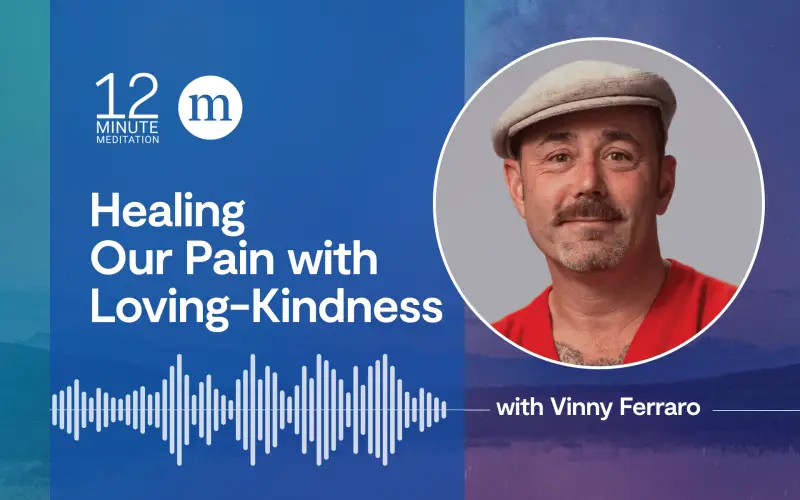
Turning toward pain on purpose sounds backwards. When something hurts or frightens us, the reflex is to pull away. Vinny Ferraro, a long-time insight meditation teacher, argues that this reflex is not a personal failing. It's wired in. We are descended from nervous animals, and our bodies are built to flinch first and ask questions later. Ferraro's point is that a kind, friendly presence toward difficulty might be a skill worth building, precisely because it doesn't come naturally.
Here's the thing that makes the practice interesting: it isn't really about making pain disappear. It's about changing our relationship to it, and that relationship often adds more weight than the original sensation does.
The second arrow and the formula
Many meditation traditions use the image of the "second arrow." The first arrow is the painful event or feeling itself. It hits, and we can't control that. The second arrow is what we fire at ourselves: the resistance, the judgment, the story about why this shouldn't be happening or why we're the sort of person it happens to. Ferraro condenses this into a simple formula: Experience x Resistance = Suffering.
Read that way, the math is encouraging. We have limited say over what arises in our lives. We have more say over where we place our attention and how hard we push against what's already there. That doesn't mean the first arrow doesn't hurt. It means the extra suffering we add on top of it is at least partly within reach.
Ferraro also flags a common trap. In the middle of hardship, the mind tends to reach for comparisons: at least it's not this, at least it's not that. He admits that when he refuses to meet something difficult with compassion, he can feel bullied into gratitude. Gratitude that's forced doesn't do much for anyone. His suggestion is to accept that resistance is normal and let it be there too, rather than arguing it out of existence.
Why self-compassion is the hard part
Most people will extend warmth to a friend in trouble without much effort. Turning that same warmth inward is harder. Ferraro points to a few reasons. Our culture offers many ways to opt out of caring for ourselves. We worry that taking care of our own needs is self-indulgent. Some of us come to see ourselves as an inconvenience. And judgment is quick: it's easy to slide from "this hurts" into "something is wrong with me for hurting."
He also points to the cost of living in constant internal conflict. What is the real cost of being at war with ourselves, or some part of ourselves? Ferraro's question is less rhetorical than it sounds. Chronic self-criticism takes energy, and it often keeps us from fully living the parts of life that are happening right now. Ferraro frames compassion practice as a way of making room for that life, rather than waiting until we feel worthy of it.
Willingness and clear seeing
The practice rests on two qualities, which Ferraro describes as willingness and seeing clearly. Willingness means being prepared to make contact with pain and soften toward it rather than bracing against it. Clear seeing means getting curious about what the pain actually is, moment to moment.
In concrete terms, that curiosity looks like tuning into the body. Where is the sensation? Is there a shift in temperature? Is there throbbing? Is it moving, or holding still? Does it have a center, or edges? Are there places nearby where it isn't present? Ferraro suggests that the question "why is this happening to me?" and the stories we build around pain can pull us away from direct experience. Asking instead about the felt sense of the pain keeps us in the present.
He's also clear that this isn't a forced march. If an experience becomes overwhelming, the advice is to let awareness drift toward a part of the body or experience that feels calmer, and return to that steadier ground before coming back to the difficulty. Mindfulness, in this framing, is the ability to see what's arising clearly enough that we aren't swept away by it.
Widening the circle of care
Ferraro describes a progression that moves outward in stages. The practice begins with people we love most, then moves to ourselves, then to neutral people, and finally to everyone, including people who are difficult for us. Starting with self is the stage that tends to feel the most uncomfortable for many practitioners, and Ferraro is candid about that.
He admits that he moves through all four categories in a single sitting. Some days he's easy to care about. Some days self-compassion is hard to reach. Some days he feels neutral toward himself. For him, the moments when he most needs love are often the moments he messes up, and those are also when it becomes clear whether his care is conditional. Is it only there as long as he acts well? Ferraro's aim is to widen the range of situations in which he's willing to meet himself.
A caution he repeats: the practice should never be used as another tool for judgment. Its purpose is to offer ourselves a kind of pardon, especially in the places where we feel most unmet.
A guided practice you can try
The steps below paraphrase the structure Ferraro uses. Pause after each one, and don't rush. Listening to a recorded version may help some people, and the original article also includes a video and audio version of the practice.
- Turn your awareness inward. Soften your gaze and let your body soften with it.
- Set a simple intention. You're not trying to fix yourself. You're meeting yourself, and whatever is arising, with warmth. Ferraro quotes the writer Bob Sharples, who described meditation as an act of deep, warm friendship with oneself rather than an attempt to improve or redeem oneself.
- Bring to mind someone you held in compassion in the previous practice. Reconnect with the feeling that you want them to be free from suffering. Then imagine that person turning toward you with the same tenderness. Phrases that might help include: I care about your difficulties. May you be held in compassion. May your heart be at peace.
- Take in their wishes as fully as you can. Let the well-wishing touch your heart, without needing to deserve it.
- Direct the same phrases toward yourself. I care about my difficulties. May I be held in compassion. May my heart be at peace. Whatever gets in the way is worth noticing, but noticing isn't a reason to criticize yourself. It simply shows where the care is most needed.
- Gently hold whatever is arising. Over time, the aim is to make planting these seeds of compassion a habit.
Afterward, Ferraro suggests watching for moments of compassion in ordinary days. Notice where it arises naturally and where it could use more cultivation. Spending a few minutes reflecting on your intention for the practice can help.
What this does and doesn't tell us
It's worth being clear about what kind of material this is. Ferraro's piece is a teaching essay from a meditation practitioner, not a clinical study. It doesn't report trial results, measure outcomes, or compare the practice with other treatments. What it offers is a framework and a set of experiential instructions, drawn from decades of teaching work with adults and young people.
That makes it useful as a way to think about how we relate to difficulty, but it isn't a substitute for medical or mental health care. Compassion practice doesn't replace a diagnosis, treatment, or medication. If pain is persistent, severe, or changing, or if self-criticism is leading to feelings of hopelessness, talking with a doctor, a licensed therapist, or a pharmacist is the sensible next step. Meditation can sit alongside that care, but it shouldn't be used to delay it.
For most readers, the practical takeaway is modest and worth trying: notice where your resistance is adding to your pain, and see whether a few minutes of curious, gentle attention changes the texture of the experience. Ferraro's bet is that the second arrow is often the one we can most easily set down. It's a bet that's easy to test in a single week, and hard to know the value of without trying.
About the author

Vinny Ferraro has practiced insight meditation (vipassanā) since the early 1990s. He co-founded the Dharma Punx and co-guides the Against the Stream Buddhist Meditation Society. He is Senior Trainer for Mindful Schools and has spent years designing mindfulness programs for at-risk adolescents, beginning with groups in drug rehabilitation centers, juvenile halls, and halfway houses in 1987. Earlier, he served as Director of Training for Challenge Day, a social and emotional learning program, and has led workshops for more than 110,000 young people on four continents.