Liver Enzyme EPHX1 Linked to Fibrosis in Human Samples and Mice
A study links higher liver EPHX1 with altered fat metabolites and fibrosis, but treatments and blood tests based on the pathway need more research.
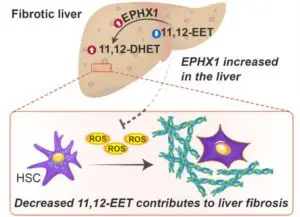
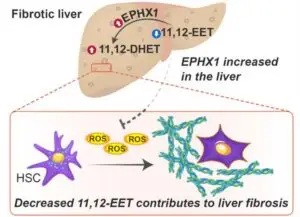
An enzyme that changes how the liver processes certain fats was higher in samples from people with advanced fibrosis and in mice with the condition, researchers report. Their experiments link that enzyme, EPHX1, to lower levels of a potentially protective fat metabolite and to processes associated with scarring. The findings point to a pathway for further study; they don’t show that changing it can prevent or treat liver disease in people.
A shift in fat metabolites
The study, led by Hiroko Ikenaga, MD, PhD, and Associate Professor Tsutomu Matsubara, PhD, at Osaka Metropolitan University’s Graduate School of Medicine, focused on metabolites made when the body processes dietary polyunsaturated fats. One of these, 11,12-epoxyeicosatrienoic acid (11,12-EET), has been associated with anti-inflammatory and protective effects in the liver.
EPHX1 converts EETs into related compounds called dihydroxyeicosatrienoic acids, or DHETs. In the study, higher levels of EPHX1 were associated with less 11,12-EET and more of its corresponding product, 11,12-DHET. This pattern offers a possible explanation for how a change in fat metabolism may accompany liver scarring: increased conversion could reduce the amount of EET available while raising DHET levels.
The researchers found this pattern in liver samples from both mice and people with advanced fibrosis. Those observations establish an association in human tissue, but they cannot show by themselves that EPHX1 caused the fibrosis. The experiments in mice and liver cells provide additional evidence about a possible mechanism.
What the experiments suggest
Mice bred without the EPHX1 enzyme had more 11,12-EET and showed less production of fibrous tissue and less oxidative stress associated with advanced fibrosis. Oxidative stress refers to harmful chemical activity that can damage cells. The results suggest that reducing EPHX1 may change the balance of these metabolites and affect processes linked to scarring in this animal model.
The team also treated hepatic stellate cells with 11,12-EET. These liver cells help regulate tissue repair and can become activated in ways that contribute to fibrosis. In the laboratory experiments, EET treatment reduced oxidative stress and suppressed activation induced by transforming growth factor beta, a signal involved in fibrotic changes. Cell experiments help researchers examine biological processes, but they do not establish that the same effects will occur in a person taking a treatment.
Together, the mouse and cell findings support a proposed chain of events: EPHX1 increases the conversion of EETs into DHETs, EET levels fall, and processes associated with oxidative stress and scar formation become more prominent. The evidence is an early step toward understanding that pathway. It does not yet establish how much EPHX1 contributes to disease progression compared with other biological factors.
Why the pathway matters
Metabolic dysfunction-associated steatotic liver disease (MASLD) affects an estimated 25% of the world’s population, according to the study authors, and they expect its prevalence to rise. In some people, MASLD progresses to metabolic dysfunction-associated steatohepatitis (MASH), which can involve inflammation and fibrosis. Advanced scarring can progress to cirrhosis and may be associated with liver cancer.
Fibrosis is the buildup of scar tissue in the liver. Its severity can vary, and findings about a pathway linked to advanced fibrosis do not mean that everyone with MASLD will develop severe disease. The study adds to a field of research examining how lipid metabolites may relate to liver disease, while the authors say that the effects of these compounds on fibrosis remain incompletely understood.
The team proposes that 11,12-DHET levels in blood could be investigated as a possible marker of more advanced fibrosis. A biomarker is a measurable feature that may help researchers assess a biological process or identify patterns associated with disease. The study’s findings do not establish that a blood test for 11,12-DHET is accurate or ready for routine care. Further research would need to determine whether the marker reliably reflects fibrosis severity and adds useful information to existing clinical assessments.
What remains before clinical use
The researchers describe reducing EPHX1 activity or preserving 11,12-EET activity as possible therapeutic approaches. But a potential target is not the same as an available or proven treatment. The study did not test a therapy in people, and the authors note that human drugs that inhibit EPHX1 are lacking. They also report that compounds affecting 11,12-EET are unstable, and say that stability and safety need to be addressed before clinical use can be considered.
The findings were reported in JCI Insight in the study “Hepatic EPHX1 Potentiates Liver Fibrosis by Decreasing Eicosatrienoic Acids.” Follow-up work will need to clarify how the pathway behaves across different stages of liver disease, whether 11,12-DHET can serve as a dependable marker, and whether targeting EPHX1 can be done safely in people. For now, the results offer a research lead on liver scarring, not a basis for changing care. People with questions about liver health or test results can discuss them with a clinician.